


Page 26 - LOTN Advent issue 57
P. 26
FAITH AND CULTURE

          Most notably: when the Lord wishes to encourage the   No more will he know the streams of oil, or the torrents of
        Israelites enslaved in Egypt, or subsequently wandering in  honey and cream (Jb 20:17).
        the desert, he speaks of Canaan, the Promised Land, as a   On the other hand, there are always dangers in excess. So
        land flowing with milk and honey (Ex 3:8 etc.) We Christians  the Book of Proverbs insists:
        of course take this as an image of heaven, the desired   Eat to your satisfaction what honey you may find, but not
        destination of our earthly pilgrimage, and our only true  to excess, or you will bring it up again (Prov 25:16; see also
        homeland. In the ancient Church, the newly baptised were  25:27; 27:7).
        sometimes invited to take both milk and honey, as a symbol   To end on a high point: according to several early Greek
        of their entry into the Kingdom of God, or as a foretaste of  New  Testament Manuscripts, the Risen Lord himself, on
        the delights of heaven to come.                       the very Day of Easter, ate some honeycomb. That variant
          In the Song of Songs,  the Bridegroom  searches for  reading is followed in the Latin Vulgate Bible; also in the
        adequate images with which to praise his adored Beloved:   Authorised (King James) version. This occurred during the
          Your lips, my promised Bride, distil wild honey. Honey and  Lord’s appearance to the assembled disciples, according
        milk are under your tongue, and the scent of your garments  to St Luke (Lk 24:42). Our modern versions, including the
        is like the scent of Lebanon (Song of Songs 4:11; cf. also 5:1).  Nova Vulgata, tend to speak here only of dried or grilled
          Or, by contrast, in the Book of Job, Zophar the Naamathite  fish. How much nicer that would have been though, with a
        reflects on the inevitable come-uppance of the wicked:   little honey on top!


          Oot an Aboot


          with Ron Smith


         The enchanted                                        been there at that time. Eventually, Haakon turned up with no
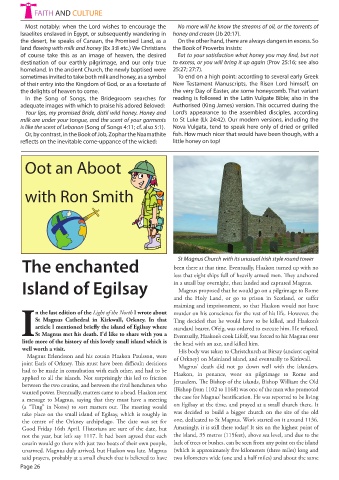
                                                                St Magnus Church with its unusual Irish style round tower

                                                              less that eight ships full of heavily armed men. They anchored
         Island of Egilsay                                    in a small bay overnight, then landed and captured Magnus.
                                                                Magnus proposed that he would go on a pilgrimage to Rome
                                                              and  the  Holy  Land,  or  go  to  prison  in  Scotland,  or  suffer
                                                              maiming and imprisonment, so that Haakon would not have
             n the last edition of the Light of the North I wrote about  murder on his conscience for the rest of his life. However, the
             St  Magnus  Cathedral  in  Kirkwall,  Orkney.  In  that   Ting decided that he would have to be killed, and Haakon’s
             article I mentioned briefly the island of Egilsay where   standard bearer, Ofeig, was ordered to execute him. He refused.
        ISt Magnus met his death. I'd like to share with you a   Eventually, Haakon’s cook Lifolf, was forced to hit Magnus over
         little more of the history of this lovely small island which is   the head with an axe, and killed him.
         well worth a visit.                                    His body was taken to Christchurch at Birsay (ancient capital
          Magnus Erlendsson and his cousin Haakon Paulsson, were   of Orkney) on Mainland island, and eventually to Kirkwall.
         joint Earls of Orkney. This must have been difficult; decisions   Magnus’ death did not go down well with the islanders.
         had to be made in consultation with each other, and had to be   Haakon, in penance, went on pilgrimage to Rome and
         applied to all the islands. Not surprisingly this led to friction
         between the two cousins, and between the rival henchmen who   Jerusalem. The Bishop of the islands, Bishop William the Old
         wanted power. Eventually, matters came to a head. Haakon sent   (Bishop from 1102 to 1168) was one of the men who promoted
         a message to Magnus, saying that they must have a meeting   the case for Magnus’ beatification. He was reported to be living
         (a “Ting” in Norse) to sort matters out. The meeting would   on Egilsay at the time, and prayed at a small church there. It
         take place on the small island of Egilsay, which is roughly in   was decided to build a bigger church on the site of the old
         the centre of the Orkney archipelago. The date was set for   one, dedicated to St Magnus. Work started on it around 1136.
         Good Friday 16th April. Historians are sure of the date, but   Amazingly, it is still there today! It sits on the highest point of
         not the year, but let’s say 1117. It had been agreed that each  the island, 35 metres (115feet), above sea level, and due to the
         cousin would go there with just two boats of their own people,  lack of trees or bushes, can be seen from any point on the island
         unarmed. Magnus duly arrived, but Haakon was late. Magnus  (which is approximately five kilometers (three miles) long and
         said prayers, probably at a small church that is believed to have  two kilometers wide (one and a half miles) and about the same
        Page 26

