


Page 22 - LOTN Advent issue 57
P. 22
EDUCATION AND FORMATION


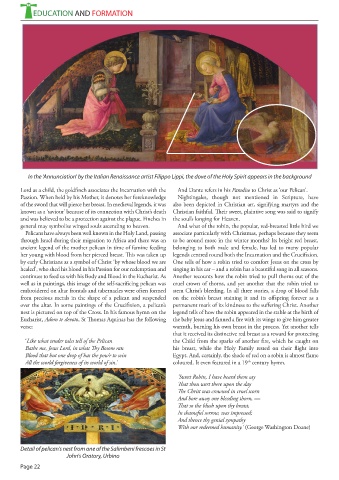
           In the 'Annunciation' by the Italian Renaissance artist Filippo Lippi, the dove of the Holy Spirit appears in the background

        Lord as a child, the goldfinch associates the Incarnation with the   And Dante refers in his Paradiso to Christ as ‘our Pelican’.
        Passion. When held by his Mother, it denotes her foreknowledge   Nightingales,  though  not  mentioned  in  Scripture,  have
        of the sword that will pierce her breast. In medieval legends, it was  also been depicted in Christian art, signifying martyrs and the
        known as a ‘saviour’ because of its connection with Christ’s death  Christian faithful. Their sweet, plaintive song was said to signify
        and was believed to be a protection against the plague. Finches in  the soul’s longing for Heaven.
        general may symbolise winged souls ascending to heaven.  And what of the robin, the popular, red-breasted little bird we
          Pelicans have always been well known in the Holy Land, passing  associate particularly with Christmas, perhaps because they seem
        through Israel during their migration to Africa and there was an  to be around more in the winter months? Its bright red breast,
        ancient legend of the mother pelican in time of famine feeding  belonging to both male and female, has led to many popular
        her young with blood from her pierced breast. This was taken up  legends centred round both the Incarnation and the Crucifixion.
        by early Christians as a symbol of Christ ‘by whose blood we are  One tells of how a robin tried to comfort Jesus on the cross by
        healed’, who shed his blood in his Passion for our redemption and  singing in his ear – and a robin has a beautiful song in all seasons.
        continues to feed us with his Body and Blood in the Eucharist. As  Another recounts how the robin tried to pull thorns out of the
        well as in paintings, this image of the self-sacrificing pelican was  cruel crown of thorns, and yet another that the robin tried to
        embroidered on altar frontals and tabernacles were often formed  stem Christ’s bleeding. In all three stories, a drop of blood falls
        from precious metals in the shape of a pelican and suspended  on  the  robin’s breast  staining it and  its  offspring forever  as  a
        over the altar. In some paintings of the Crucifixion, a pelican’s  permanent mark of its kindness to the suffering Christ. Another
        nest is pictured on top of the Cross. In his famous hymn on the  legend tells of how the robin appeared in the stable at the birth of
        Eucharist, Adoro te devoto, St Thomas Aquinas has the following  the baby Jesus and fanned a fire with its wings to give him greater
        verse:                                                warmth, burning his own breast in the process. Yet another tells
                                                              that it received its distinctive red breast as a reward for protecting
          ‘Like what tender tales tell of the Pelican         the Child from the sparks of another fire, which he caught on
          Bathe me, Jesus Lord, in what Thy Bosom ran         his breast, while the Holy Family rested on their flight into
          Blood that but one drop of has the pow’r to win     Egypt. And, certainly, the shade of red on a robin is almost flame
          All the world forgiveness of its world of sin.’     coloured. It even featured in a 19  century hymn.
                                                                                        th
                                                               'Sweet Robin, I have heard them say
                                                               That thou wert there upon the day
                                                               The Christ was crowned in cruel scorn
                                                               And bore away one bleeding thorn, —
                                                               That so the blush upon thy breast,
                                                               In shameful sorrow, was impressed;
                                                               And thence thy genial sympathy
                                                               With our redeemed humanity.' (George Washington Doane)


        Detail of pelican's nest from one of the Salimbeni frescoes in St
                        John's Oratory, Urbino

        Page 22

