


Page 27 - LOTN Advent issue 57
P. 27
FAITH AND CULTURE

        distance from neighbouring islands as well.
          The church has a round tower, which is believed to be unique
        in Britain, and was 20 metres (66 feet) high, with a domed roof
        and probably a bell. Today it is a little truncated, 15 metres
        (49 feet) high. It has just one doorway, into the central nave.
        The stone roof over the rectangular nave and square chancel
        was removed in 1847 - maybe this was when services stopped
        being held there. There was an upper story over the chancel. It
        is in remarkable condition, and Historic Scotland are looking
        after it well. It stands in a graveyard, and is easily accessible. It
        is remarkable that this extremely well constructed church is still
        withstanding the Orkney weather, 888 years after it was built.
          Not so far away, and again, it cannot be missed as there is so
        little natural growth of trees or shrubs, is a large, solid looking
        monument. This has a plaque on it which reads:
          “Erected by the Rector and Congregation of the Church of St
        Magnus the Martyr, by London Bridge, and the Minister and
        Congregation of St Magnus Cathedral, Kirkwall, to mark the
        traditional spot where Earl Magnus was slain. A.D. c. 1116, and
        to commemorate the Octocentenary of St Magnus Cathedral,
        1937”.
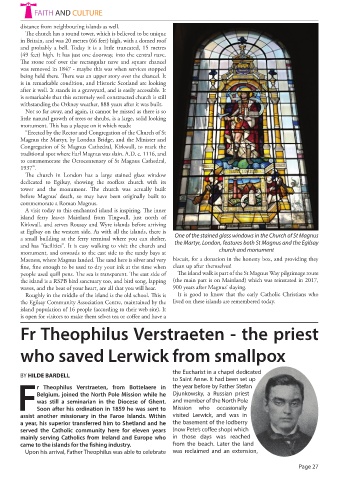
          The church in London has a large stained glass window
        dedicated to Egilsay, showing the roofless church with its
        tower and the monument. The church was actually built
        before Magnus’ death, so may have been originally built to
        commemorate a Roman Magnus.
          A visit today to this enchanted island is inspiring. The inner
        island ferry leaves Mainland from  Tingwall, just north of
        Kirkwall, and serves Rousay and Wyre islands before arriving
        at Egilsay on the western side. As with all the islands, there is
        a small building at the ferry terminal where you can shelter,   One of the stained glass windows in the Church of St Magnus
        and has “facilities”. It is easy walking to visit the church and   the Martyr, London, features both St Magnus and the Egilsay
        monument, and onwards to the east side to the sandy bays at           church and monument
        Maeness, where Magnus landed. The sand here is silver and very  biscuit, for a donation in the honesty box, and providing they
        fine, fine enough to be used to dry your ink at the time when  clean up after themselves!
        people used quill pens. The sea is transparent. The east side of   The island walk is part of the St Magnus Way pilgrimage route
        the island is a RSPB bird sanctuary too, and bird song, lapping  (the main part is on Mainland) which was reinstated in 2017,
        waves, and the beat of your heart, are all that you will hear.  900 years after Magnus’ slaying.
          Roughly in the middle of the island is the old school. This is   It is good to know that the early Catholic Christians who
        the Egilsay Community Association Centre, maintained by the  lived on these islands are remembered today.
        island population of 16 people (according to their web site). It
        is open for visitors to make them selves tea or coffee and have a

        Fr Theophilus Verstraeten - the priest


        who saved Lerwick from smallpox


                                                              the Eucharist in a chapel dedicated
        BY HILDE BARDELL
                                                              to Saint Anne. It had been set up
              r  Theophilus  Verstraeten, from Bottelaere in  the year before by Father Stefan
              Belgium, joined the North Pole Mission while he  Djunkowsky,  a Russian  priest
              was still  a seminarian in  the Diocese of Ghent.  and member of the North Pole
       FSoon after his ordination in 1859 he was sent to  Mission who occasionally
        assist  another  missionary in  the  Faroe  Islands.  Within  visited Lerwick, and was in
        a year, his superior transferred him to Shetland and he  the basement of the lodberry
        served the Catholic community here for eleven years  (now Pete’s coffee shop) which
        mainly serving Catholics from Ireland and Europe who  in those days was reached
        came to the islands for the fishing industry.         from the beach. Later the land
          Upon his arrival, Father Theophilus was able to celebrate  was reclaimed and an extension,


                                                                                                          Page 27

