


Page 30 - LOTN Advent issue 57
P. 30
FAITH AND CULTURE
        Witold Pilecki - The Auschwitz Volunteer


          The 5th of September this year marked the 12th anniversary
        of the posthumous promotion of the late cavalry officer Witold
        Pilecki to the rank of colonel of the Polish army. He was an
        extraordinary figure, a model for subsequent generations of
        Poles and all those who search in their hearts for what is right
        and juSt In the 1970s, the British historian Michael Foot, in his
        book Six Faces of Courage, recognized Witold as one of the six
        bravest heroes of World War II, and in the second of two articles
        Lidia Konar documents Witold's escape from Auschwitz and
        the continuation of his fight for Polish independence.


        BY LIDIA KONAR

              ilecki spent two years  and  seven months  in the
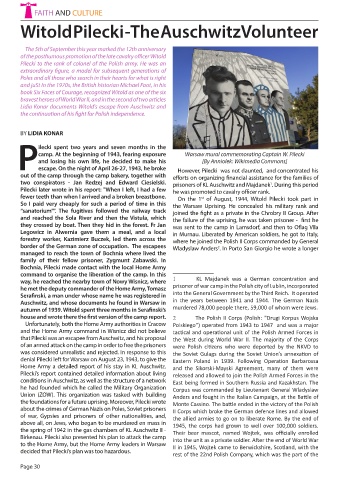
              camp. At the beginning of 1943, fearing exposure    Warsaw mural commemorating Captain W. Pilecki
              and  losing  his  own  life,  he decided  to  make  his   [By Anniolek: Wikimedia Commons]
       Pescape. On the night of April 26-27, 1943, he broke    However, Pilecki  was not daunted,  and concentrated his
        out of the camp through the camp bakery, together with   efforts on organizing financial assistance for the families of
        two conspirators - Jan Redzej and Edward Ciesielski.   prisoners of KL Auschwitz and Majdanek . During this period
                                                                                                1
        Pilecki later wrote in his report: "When I left, I had a few   he was promoted to cavalry officer rank.
        fewer teeth than when I arrived and a broken breastbone.   On the 1  of August, 1944,  Witold Pilecki took part in
                                                                        st
        So  I paid very  cheaply  for  such  a period of time  in this   the  Warsaw Uprising. He concealed his military rank and
        “sanatorium””.  The fugitives followed the railway track   joined the fight as a private in the Chrobry II Group. After
        and reached the Sola River and then the Vistula, which   the failure of the uprising, he was taken prisoner -  first he
        they crossed by boat. Then they hid in the forest. Fr Jan   was sent to the camp in Lamsdorf, and then to Oflag VIIa
        Legowicz in Alwernia gave them a meal, and a local    in Murnau. Liberated by American soldiers, he got to Italy,
        forestry worker, Kazimierz Buczek, led them across the   where he joined the Polish II Corps commanded by General
        border of the German zone of occupation.  The escapees   Wladyslaw Anders . In Porto San Giorgio he wrote a longer
                                                                              2
        managed to reach the town of Bochnia where lived the
        family of their fellow prisoner, Zygmunt Zabawski. In
        Bochnia, Pilecki made contact with the local Home Army
        command to organise the liberation of the camp. In this
        way, he reached the nearby town of Nowy Wisnicz, where   1     KL  Majdanek  was  a  German  concentration  and
        he met the deputy commander of the Home Army, Tomasz   prisoner of war camp in the Polish city of Lublin, incorporated
        Serafinski, a man under whose name he was registered in   into the General Government by the Third Reich.  It operated
        Auschwitz, and whose documents he found in Warsaw in   in  the years between 1941 and  1944. The  German Nazis
        autumn of 1939. Witold spent three months in Serafinski’s   murdered 78,000 people there, 59,000 of whom were Jews.
        house and wrote there the first version of the camp report.  2    The Polish II Corps (Polish: "Drugi Korpus Wojska
          Unfortunately, both the Home Army authorities in Cracow  Polskiego”) operated from 1943 to 1947  and was a major
        and the Home Army command in Wisnicz did not believe   tactical and operational unit of the Polish Armed Forces in
        that Pilecki was an escapee from Auschwitz, and his proposal   the West during  World  War  II. The majority of the Corps
        of an armed attack on the camp in order to free the prisoners   were  Polish  citizens  who  were  deported  by  the  NKVD  to
        was considered unrealistic and rejected. In response to this   the Soviet Gulags during the Soviet Union’s annexation of
        denial Pilecki left for Warsaw on August 23, 1943, to give the   Eastern  Poland  in  1939.  Following  Operation  Barbarossa
        Home Army a detailed report of his stay in KL Auschwitz.   and  the  Sikorski-Mayski  Agreement,  many  of  them  were
        Pilecki’s report contained detailed information about living   released and allowed to join the Polish Armed Forces in the
        conditions in Auschwitz, as well as the structure of a network   East being formed in Southern Russia and Kazakhstan. The
        he had founded which he called the Military Organization   Corpus was commanded by Lieutenant General Wladyslaw
        Union (ZOW). This  organization  was  tasked  with  building   Anders and fought in the Italian Campaign, at the Battle of
        the foundations for a future uprising. Moreover, Pilecki wrote   Monte Cassino. The battle ended in the victory of the Polish
        about the crimes of German Nazis on Poles, Soviet prisoners   II Corps which broke the German defence lines and allowed
        of war, Gypsies and prisoners of other nationalities, and,   the allied armies to go on to liberate Rome. By the end of
        above all, on Jews, who began to be murdered en mass in   1945,  the corps had  grown to well  over  100,000  soldiers.
        the spring of 1942 in the gas chambers of KL Auschwitz II -   Their  bear  mascot,  named  Wojtek,  was  officially  enrolled
        Birkenau. Pilecki also presented his plan to attack the camp   into the unit as a private soldier. After the end of World War
        to the Home Army, but the Home Army leaders in Warsaw   II in 1945, Wojtek came to Berwickshire, Scotland, with the
        decided that Pilecki’s plan was too hazardous.        rest of the 22nd Polish Company, which was the part of the


        Page 30

