


Page 31 - LOTN Advent issue 57
P. 31
FAITH AND CULTURE

        version of his report from KL
        Auschwitz, a copy of which
        he gave to General Tadeusz
        Pelczynski. In the autumn
        of 1945 he returned to
        Poland under the name
        of Roman Jezierski.   The
        German    occupiers  had
        withdrawn, but with the
        Soviets, a  no  less  barbaric
        rule was established. In the
        country, Pilecki  conducted
        intelligence    activities
        for II Corps, to which he
        sent information about
        the social and political
        conditions in the country,
        and about the repression
        of the Polish population by
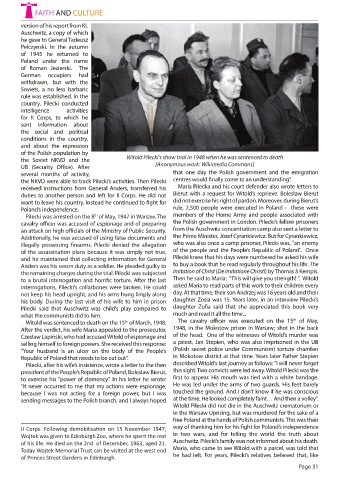
        the Soviet NKVD and the              Witold Pilecki's show trial in 1948 when he was sentenced to death
        UB (Security Office). After                     [Anonymous work: Wikimedia Commons]
        several months of activity,                           that  one  day  the  Polish  government  and  the  emigration
        the NKVD were able to track Pilecki’s activities. Then Pilecki   centres would finally come to an understanding”.
        received  instructions  from  General  Anders,  transferred  his   Maria Pilecka and his court defender also wrote letters to
        duties to another person and left for II Corps. He did not   Bierut with a request for Witold’s reprieve. Bolesław Bierut
        want to leave his country. Instead he continued to fight for   did not exercise his right of pardon. Moreover, during Bierut’s
        Poland’s independence.                                rule, 2,500 people were executed in Poland -  these were
          Pilecki was arrested on the 8  of May, 1947 in Warsaw. The   members of the Home Army and people associated with
                                  th
        cavalry officer was accused of espionage and of preparing   the Polish government in London. Pilecki’s fellow prisoners
        an attack on high officials of the Ministry of Public Security.   from the Auschwitz concentration camp also sent a letter to
        Additionally, he was accused of using false documents and   the Prime Minister, Józef Cyrankiewicz. But for Cyrankiewicz,
        illegally possessing firearms. Pilecki denied the allegation   who was also once a camp prisoner, Pilecki was, "an enemy
        of the assassination plans because it was simply not true,   of the people and the People’s Republic of Poland".  Once
        and he maintained that collecting information for General   Pilecki knew that his days were numbered he asked his wife
        Anders was his sworn duty as a soldier. He pleaded guilty to   to buy a book that he read regularly throughout his life: The
        the remaining charges during the trial. Pilecki was subjected   Imitation of Christ (De imitatione Christi) by Thomas à Kempis.
        to a brutal interrogation and horrific torture. After the last   Then he said to Maria:  "This will give you strength! ”.  Witold
        interrogations, Pilecki's collarbones were broken. He could   asked Maria to read parts of this work to their children every
        not keep his head upright, and his arms hung limply along   day. At that time, their son Andrzej was 16 years old and their
        his body. During the last visit of his wife to him in prison   daughter Zosia was 15. Years later, in an interview Pilecki’s
        Pilecki said that  Auschwitz was child's play compared to   daughter Zofia said that she appreciated this book very
        what the communists did to him.                       much and read it all the time...
                                                                                                        th
          Witold was sentenced to death on the 15  of March, 1948.     The  cavalry  officer  was  executed  on  the  15   of  May,
                                             th
        After the verdict, his wife Maria appealed to the prosecutor,   1948, in the Mokotow prison in Warsaw; shot in the back
        Czeslaw Lapinski, who had accused Witold of espionage and   of the head.  One of the witnesses of Witold’s murder was
        selling himself to foreign powers. She received this response:   a priest, Jan Stepien, who was also imprisoned in the UB
        "Your  husband  is  an  ulcer  on  the  body  of  the People’s   (Polish secret police under Communism) torture chamber
        Republic of Poland that needs to be cut out”.         in Mokotow district at that time. Years later Father Stepien
          Pilecki, after his wife’s insistence, wrote a letter to the then   described Witold’s last journey as follows: "I will never forget
        president of the People’s Republic of Poland, Boleslaw Bierut,   this sight. Two convicts were led away. Witold Pilecki was the
        to exercise his "power of clemency". In his letter he wrote:   first to appear. His mouth was tied with a white bandage.
        "It never occurred to me that my actions were espionage,   He was led under the arms of two guards. His feet barely
        because  I  was  not  acting  for  a  foreign  power,  but  I  was   touched the ground. And I don’t know if he was conscious
        sending messages to the Polish branch, and I always hoped   at the time. He looked completely faint… And then a volley”.
                                                              Witold Pilecki did not die in the Auschwitz crematorium or
                                                              in the Warsaw Uprising, but was murdered for the sake of a
                                                              free Poland at the hands of Polish communists. This was their
        II  Corps.  Following  demobilisation  on  15  November  1947,   way of thanking him for his fight for Poland’s independence
        Wojtek was given to Edinburgh Zoo, where he spent the rest   in two wars, and for telling the world the truth about
        of his life. He died on the 2nd  of December, 1963, aged 21.   Auschwitz. Pilecki’s family was not informed about his death.
        Today Wojtek Memorial Trust can be visited at the west end   Maria, who came to see Witold with a parcel, was told that
        of Princes Street Gardens in Edinburgh.               he had left. For years, Pilecki’s relatives believed that, like

                                                                                                          Page 31

