


Page 28 - LOTN Advent issue 57
P. 28
FAITH AND CULTURE

                                                              Fr Verstraeten was approached on this issue by the Procurator
                                                              Fiscal Baillie Duncan, who acted as the Belgian Consul. Then,
                                                              Fr Fitzgibbon writes, he made the 'unusual' decision to
                                                              voluntarily go onboard and persuade the captain to move his
                                                              ship out of the nearby bay. The result was a tragedy: "Though
                                                              Father Verstraeten's visit onboard Le Phare had secured the
                                                              town from infection, it proved fatal for him." He had given a
                                                              sick crew member the last rites and got smallpox himself. The
                                                              crewman recovered, but he died a short time later, “victim of
                                                              his zeal and self-denial.”
                                                               Immediately after his death, his house was thoroughly
                                                              cleaned and disinfected. Other residents had to remain in
                                                              quarantine and were not allowed to communicate with others.
                                                              A guard was put in front of the door. Father Verstraeten's body
                                                              was immediately placed in a lead coffin. A short time later, the
        A chapel dedicated to St Anne once occupied the basement of   ship, which he had boarded some days previously as a healthy
                     what is now Pete's Coffee Shop           man, brought his body to Ostend and from there to Bottelaere
        present in the 1860s, has been demolished. Eventually Mass   near Ghent to be buried there.
        was celebrated in the Zetland Hotel, now the Shetland   A few words from the Belgian consul in his obituary make
        Times Bookshop.                                       it clear that Fr Verstraeten had left a strong impression in
          Fr Verstraeten’s arrival was not appreciated by everyone.   the ten years of his ministry in Shetland:
        Three hundred years after the Protestant Reformation, in   "It is impossible to describe the sadness that this sad
        Scotland the North Pole mission was considered as ‘papist   event has caused in the town where it is seen as a general
        aggression’. In Shetland  the mission was preached against   disaster. Our friend had acquired the affection of all classes
        and one night a fanatical opponent set off a gunpowder   in society through his kindness, his godliness, his great and
        explosion around Father  Verstraeten’s lodgings, blowing   also moral charity, always willing to do all possible services,
                                                              even in a land of strict Presbyterians, who do not tolerate
                                                              the Catholic Religion.”
                                                               A few days later, the minutes of the Burgh Town Council
                                                              read:
                                                               “Before moving to Business, the Meeting deemed it due
                                                              to the memory of the lamented Mr Verstraeten, late resident
                                                              Catholic priest, to put on record their deep sense of the loss
                                                              of one who during a residence of nearly ten years among
                                                              a community of strict Protestants had not only lived down
                                                              all religious prejudice but had personally won the respect
                                                              and esteem of all classes by the unobtrusive discharge of
                                                              his  professional  duties,  and  his  amiable  disposition,  and
                                                              who latterly fell a sacrifice to his praiseworthy endeavour
                                                              to protect the community from the plague of smallpox."
                                                               These minutes can be read on a plaque which was placed
                                                              in honour of Father Verstraeten in St Margaret's Church in
        Eventually Mass was celebrated in the Zetland Hotel, now the   Lerwick.
                       Shetland Times Bookshop.                Fr Verstraeten's body was taken back to his home village

        out the windows. Nevertheless, he worked hard to reverse
        this hostility, until his untimely death at the age of 39 years.
          In 1871, Le Phare, a Belgian fishing smack, had anchored
        near Lerwick. A year earlier, in 1870, a pandemic of
        smallpox had broken out in Europe, the largest outbreak
        since the introduction of smallpox vaccination at the end of
        the eighteenth century. The news that a sailor on the ship
        was sick with smallpox caused a quick response in Lerwick
        where people could probably remember the horror of
        previous outbreaks, in which some islands had almost
        been completely depopulated. The ship was quarantined
        and any communication between population and ship was
        prohibited.
          Father Gerald Fitzgibbon, a former Lerwick parish priest,
        who published Father Verstraeten's story in 1994 (Shetland Life
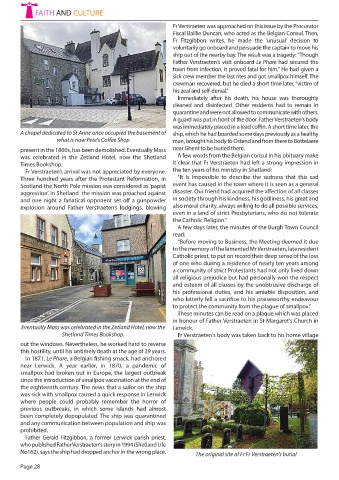
        No162), says the ship had dropped anchor in the wrong place.   The original site of Fr Fr Verstraeten's burial


        Page 28

