


Page 23 - LOTN Advent issue 57
P. 23
FAITH AND CULTURE
        ‘Gregorian chant’


        a misnomer?


        BY DR SHELAGH NODEN

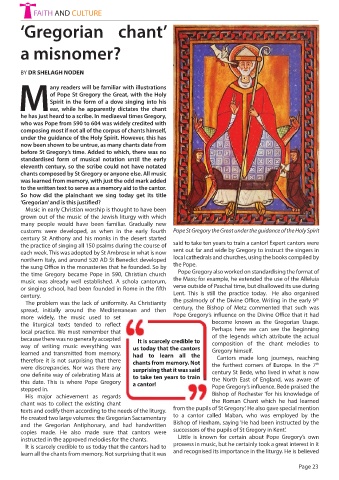
                   any readers will be familiar with illustrations
                   of Pope St Gregory the Great, with the Holy
                   Spirit in the form of a dove singing into his
        Mear, while he apparently dictates the chant
        he has just heard to a scribe. In mediaeval times Gregory,
        who was Pope from 590 to 604 was widely credited with
        composing most if not all of the corpus of chants himself,
        under the guidance of the Holy Spirit. However, this has
        now been shown to be untrue, as many chants date from
        before St Gregory’s time. Added to which, there was no
        standardised form of musical notation until the early
        eleventh century, so the scribe could not have notated
        chants composed by St Gregory or anyone else. All music
        was learned from memory, with just the odd mark added
        to the written text to serve as a memory aid to the cantor.
        So how did the plainchant we sing today get its title
        ‘Gregorian’ and is this justified?
          Music in early Christian worship is thought to have been
        grown out of the music of the Jewish liturgy with which
        many  people  would  have  been familiar.  Gradually  new
        customs were developed, as when in the early fourth  Pope St Gregory the Great under the guidance of the Holy Spirit
        century St Anthony and his monks in the desert started
        the practice of singing all 150 psalms during the course of   said to take ten years to train a cantor! Expert cantors were
        each week. This was adopted by St Ambrose in what is now   sent out far and wide by Gregory to instruct the singers in
        northern Italy, and around 520 AD St Benedict developed   local cathedrals and churches, using the books compiled by
        the sung Office in the monasteries that he founded. So by   the Pope.
        the time Gregory became Pope in 590, Christian church   Pope Gregory also worked on standardising the format of
        music was already well established. A schola cantorum,   the Mass; for example, he extended the use of the Alleluia
        or singing school, had been founded in Rome in the fifth   verse outside of Paschal time, but disallowed its use during
        century.                                              Lent.  This is still the practice today.  He also organised
                                                                                                                th
          The problem was the lack of uniformity. As Christianity   the psalmody of the Divine Office. Writing in the early 9
        spread, initially around the Mediterranean and then   century, the Bishop of Metz commented that such was
        more widely, the music used to set                    Pope Gregory’s influence on the Divine Office that it had
        the liturgical texts tended to reflect                             become known as the Gregorian Usage.
        local practice. We must remember that                              Perhaps here we can see the beginning
        because there was no generally accepted   It is scarcely credible to   of the legends which attribute the actual
        way of writing music everything was     us today that the cantors   composition  of  the  chant  melodies  to
        learned and transmitted from memory,    had to learn all the       Gregory himself.
        therefore  it is not  surprising  that there   chants from memory. Not   Cantors made long journeys, reaching
                                                                                                                th
        were discrepancies. Nor was there any   surprising that it was said   the furthest corners of Europe. In the 7
        one definite way of celebrating Mass at   to take ten years to train   century St Bede, who lived in what is now
        this date.  This is where Pope Gregory   a cantor!                 the North East of England, was aware of
        stepped in.                                                        Pope Gregory’s influence. Bede praised the
          His major achievement as regards                                 Bishop of Rochester ‘for his knowledge of
        chant was to collect the existing chant                            the Roman Chant which he had learned
        texts and codify them according to the needs of the liturgy.   from the pupils of St Gregory’. He also gave special mention
        He created two large volumes: the Gregorian Sacramentary   to a cantor called Maban, who was employed by the
        and the Gregorian Antiphonary, and had handwritten    Bishop of Hexham, saying ‘He had been instructed by the
        copies  made.  He  also  made  sure  that  cantors  were   successors of the pupils of St Gregory in Kent’.
        instructed in the approved melodies for the chants.     Little is known for certain about Pope Gregory’s own
          It is scarcely credible to us today that the cantors had to   prowess in music, but he certainly took a great interest in it
        learn all the chants from memory. Not surprising that it was   and recognised its importance in the liturgy. He is believed

                                                                                                          Page 23

