


Page 21 - LOTN Advent issue 57
P. 21
EDUCATION AND FORMATION


         Birds in Legend


         and Symbol


         BY EILEEN CLARE GRANT

                    any birds, even though they do not appear by
                    name in Scripture, were adopted as Christian
                    symbols  or  became  associated  with  Saints  or
        Mcharacters in the Bible. The raven, for example
        is often to be found in paintings of the prophet Elijah,
        bringing him food in the wilderness.
          It is also depicted in a favourable light in relation to several
        saints: God is said to have sent another raven to guard the
        martyred body of St Vincent of Saragossa when it was thrown
        into a field. It ‘drove away all other birds and fowls, greater than
        he was, and chased away also a wolf with his bill and beak.’ The
        raven is also associated with St Antony Abbot and St Paul the
        Hermit as it brought them a loaf of bread each day when they
        lived together in the desert. As the raven symbolises solitude, it
        is often associated with hermit saints. It is connected also with
        St Benedict who fed a raven when he lived as a hermit in a cave
        and continued this practice in community. On one occasion, a
        malicious monk tried to kill St Benedict with a poisoned piece of
        bread which Benedict called on his raven to dispose of.
          The dove frequently appears in Christian paintings, as the
        symbol of the Holy Spirit, as described in the Gospels. Just as
        the Spirit hovered over the waters at the dawn of Creation, so the
        dove is seen hovering over the head of Jesus at his baptism in the
        Jordan. He is pictured regularly in paintings of the Annunciation
        to Mary – ‘The Holy Spirit will come upon you, and the power
        of the Most High will overshadow you.’ – either hovering above
        her head or zooming down from Heaven in a stream of light
        or shower of gold, as artists attempted to depict the miraculous
        conception of the Son of God. The dove of the Holy Spirit also
        appears in paintings of the ‘Mourning  Trinity’ – the Father
        holding the crucified Son in his arms and the dove hovering
        between them.
          Peacocks were symbols of immortality in ancient Greece when
        people believed the beautiful feathers didn’t decay after the
        peacock died. Early Christians adopted this symbol and so we
        often find a peacock in Christian art representing resurrection
        and eternal life. The Catacombs of Saint Gennaro in Naples
        contain a vault in which Mass was celebrated, with images of
        the peacock decorating it. It was also carved on sarcophagi.
        The thought of spiritual immortality would have been a great
        consolation to Christians during the early persecution.
          The goldfinch became known as a symbol of the Passion
        because of both its markings and its supposed diet. Because the
        goldfinch was believed to eat thorns, like those on Jesus’ crown
        as he was crucified, it became linked to the Passion. Legends also
        appeared that described this lovely bird pecking at the crown of
        thorns as Jesus walked to Calvary. As the goldfinch flew around
        Jesus’s head, a drop of his blood fell onto the goldfinch’s head
        and thus appeared the striking red markings on its head and
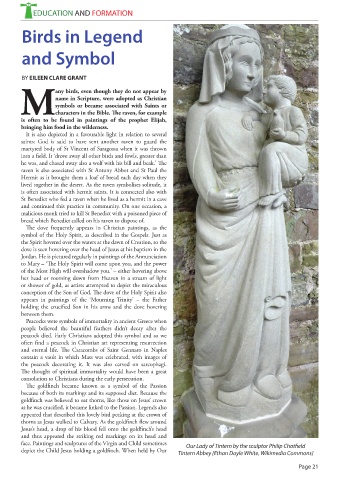
        face. Paintings and sculptures of the Virgin and Child sometimes   Our Lady of Tintern by the sculptor Philip Chatfield
        depict the Child Jesus holding a goldfinch. When held by Our   Tintern Abbey [Ethan Doyle White, Wikimedia Commons]


                                                                                                          Page 21

