


Page 33 - LOTN Advent issue 57
P. 33
FAITH AND CULTURE


                         Deacon John's

                         Autumn

                         Reflection


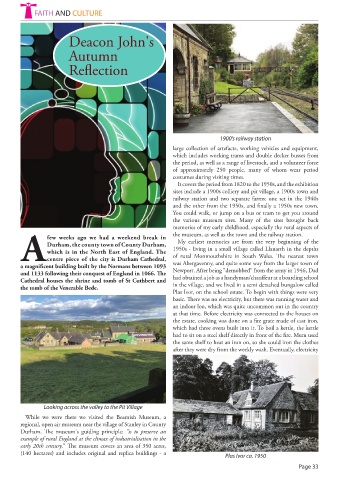
                                                                              1900’s railway station
                                                              large collection of artefacts, working vehicles and equipment,
                                                              which includes working trams and double decker busses from
                                                              the period, as well as a range of livestock, and a volunteer force
                                                              of approximately 250 people, many of whom wear period
                                                              costumes during visiting times.
                                                               It covers the period from 1820 to the 1950s, and the exhibition
                                                              sites include a 1900s colliery and pit village, a 1900s town and
                                                              railway station and two separate farms: one set in the 1940s
                                                              and the other from the 1950s, and finally a 1950s new town.
                                                              You could walk, or jump on a bus or tram to get you around
                                                              the various museum sites. Many of the sites brought back
                                                              memories of my early childhood, especially the rural aspects of
                                                              the museum, as well as the town and the railway station.
                  few weeks ago we had a weekend break in
                  Durham, the county town of County Durham,    My earliest memories are from the very beginning of the
                  which is in the North East of England. The   1950s - living in a small village called Llanarth in the depths
         A       tre piece of the city is Durham Cathedral,   of rural Monmouthshire in South  Wales. The nearest town
                  cen
        a magnificent building built by the Normans between 1093   was Abergavenny, and quite some way from the larger town of
        and 1133 following their conquest of England in 1066. The   Newport. After being "demobbed" from the army in 1946, Dad
        Cathedral houses the shrine and tomb of St Cuthbert and   had obtained a job as a handyman/chauffeur at a boarding school
        the tomb of the Venerable Bede.                       in the village, and we lived in a semi detached bungalow called
                                                              Plas Ivor, on the school estate. To begin with things were very
                                                              basic. There was no electricity, but there was running water and
                                                              an indoor loo, which was quite uncommon out in the country
                                                              at that time. Before electricity was connected to the houses on
                                                              the estate, cooking was done on a fire grate made of cast iron,
                                                              which had three ovens built into it. To boil a kettle, the kettle
                                                              had to sit on a steel shelf directly in front of the fire. Mum used
                                                              the same shelf to heat an iron on, so she could iron the clothes
                                                              after they were dry from the weekly wash. Eventually, electricity


                Looking across the valley to the Pit Village

          While we were there we visited the Beamish Museum, a
        regional, open air museum near the village of Stanley in County
        Durham. The museum's guiding principle:  "is to preserve an
        example of rural England at the climax of industrialisation in the
        early 20th century." The museum covers an area of 350 acres,
        (140 hectares) and includes original and replica buildings - a          Plas Ivor ca. 1950


                                                                                                          Page 33

