


Page 27 - LOTN Spring Issue 52 2023
P. 27
FAITH AND CULTURE

        Market at Albert Basin in 1889 and the erection of the new
        bridge giving easier access to Torry, the village began to
        grow. The open land to the west of Old Torry permitted
        curing yards, fish houses and other attendant buildings,
        including housing, to spring up unrestricted by existing
        established factories and warehouses.  The first houses
        were built in Victoria Road in 1883 (104 & 110 Victoria Road)
        and thereafter the area expanded with the greatest rapidity
        from the fishing village of medieval times to the satellite
        town that it now is.
          Because of the new technology of the steam powered
        trawl fishing boats and the lack of local skill in the new
        methods, skippers and crews from the south, especially the
        North-East of England, were imported, bringing with them
        their wives and families. In their wake came local fishermen
        eager to learn the new skills, from the coastal villages north
        and south of Aberdeen. Thus, while the major part of the   "The interior of the Church reflects the boldness of the exterior"
        population of the much-expanded area of Torry was locally  whole composition is dominated by a bold square tower
        derived, there was considerable mixture from outwith  over the crossing point of Nave and Transepts.
        the area.  To satisfy the spiritual needs of this influx of   The external walls are of granite. Unusually however,
        population with its strong element of Roman Catholics, the  these walls are not built in courses but in small polygonal
        Church of the Sacred Heart was built. On the elevated site  stones, infilling between finely dressed stone corners,
        where Inverbervie Road meets the Grampian Road, stands  string  courses  and  window  and  door  surrounds;  this
        the church boldly proclaiming its presence.           perhaps reflecting the English style of building in random
                                                              flints between finely cut limestone dressings.
                       The Church                             finish for Aberdeen where slates are more traditional, and
                                                               The roofs are clad in red rosemary tiles, an unusual roof
          The Church of the Sacred Heart, Torry, Aberdeen, stands   the roofs overfly the eaves, showing exposed rafter end
        high on an embankment, elevated above Grampian Road   sprockets expressing the internal supporting roof structure.
        where it is met by Glenbervie Road, overlooking the street   This design  detail, too,  is unusual for  Aberdeen, where
        below, and demanding notice by its commanding site and   eaves details are more spartan and areas of maintenance at
        its impressive scale.                                 high level are normally eliminated.
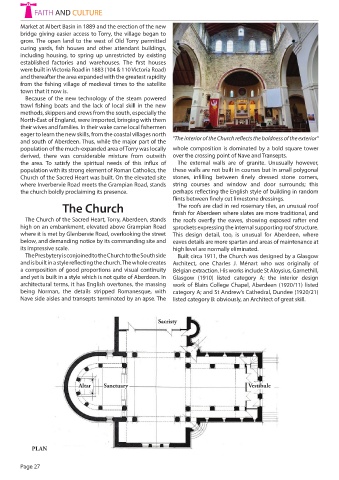
          The Presbytery is conjoined to the Church to the South side   Built circa 1911, the Church was designed by a Glasgow
        and is built in a style reflecting the church. The whole creates   Architect, one Charles J. Ménart who was originally of
        a composition of good proportions and visual continuity   Belgian extraction. His works include St Aloysius, Garnethill,
        and yet is built in a style which is not quite of Aberdeen. In   Glasgow (1910) listed category A; the interior design
        architectural terms, it has English overtones, the massing   work of Blairs College Chapel, Aberdeen (1920/11) listed
        being Norman, the details stripped Romanesque, with   category A; and St Andrew’s Cathedral, Dundee (1920/21)
        Nave side aisles and transepts terminated by an apse. The   listed category B: obviously, an Architect of great skill.


                                                         Sacristy


                             Altar   Sanctuary                                          Vestibule


            PLAN

        Page 27

