


Page 22 - LOTN Spring Issue 52 2023
P. 22
FAITH AND CULTURE

                                                               Despite this, King Brude gifted a small hill to Columba,
                                                              on the south bank of the river Ness upon which to build a
                                                              church.
                                                                The hill provided a platform from which to preach and
                                                              teach.  Today, slightly upriver on the north bank is St Mary’s
                                                              church, and as you exit through its doors you will see,
           Holy StoneS                                        cradled in the built environment of the city of Inverness,
                                                              that very mound on which Columba stood.
                                                               Looking north across the Moray Firth from King Brude's
                                                              domain, a decision was made to set sail, and as excavations
                                                              at Portmahomack have shown, there is a huge probability
                                                              that Columba was in fact the founder of a monastery
                                                              there in the sixth century. In the mix here, is evidence
                                                              that metalworking and vellum making were present -
                                                              components indeed for a scriptorium! Among the holy
                                                              stones found on-site, was one carved in relief in a formal
          In the seventh part of her series on  the "Holy" stones which   script similar to that used in the Book of Kells.
        mark our faith history in Scotland, Tina Harris continues her   The situation of Portmahomack in time and place, would
        examination of  the legacy of St Columba, the Irish abbot and   seem to link it firmly with Columba. It was the first monastery
        missionary credited with spreading Christianity in present-  to be established in Pictland, although we cannot be sure
        day Scotland.                                         that a church was included on the monastic site. Portus
        The Irish  missionary                                 Columbi, the port of Columba, or Port Maol Cholum, the


        saint who won a


        kingdom for Christ


        BY TINA HARRIS

               here is no accurate way of mapping the journeys
               of Columba in Scotland, but we do know that he
               established monastic communities on a number
        Tof the western isles and would sail eastwards
        along the southern shores of Mull, through the Firth
        of Lorne, past the strategic island of Lismore, and into
        Loch Linnhe, disembarking at what is now Fort William.
          Proceeding  overland,  the  holy  men  would  continue
        north-east, with a small enough boat to be carried overland.
          Adomnan commented that Columba visited a very poor
        man in Lochaber, who had welcomed and accommodated
        him in his family, despite his poverty. Columba blessed him,
        and the man’s wealth (cattle) increased, putting another
        place on the missionary map as well as giving a valuable
        insight into social history at that time.
          Columba’s charisma led to a role change from warlord to
        veritable diplomat among the tribes, and many miracles
        were performed during his ministry. Included, was the
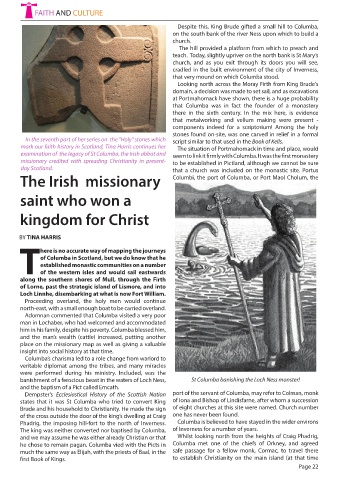
        banishment of a ferocious beast in the waters of Loch Ness,   St Columba banishing the Loch Ness monster!
        and the baptism of a Pict called Emcath.
          Dempster’s  Ecclesiastical History of the Scottish Nation   port of the servant of Columba, may refer to Colman, monk
        states that it was St Columba who tried to convert King   of Iona and Bishop of Lindisfarne, after whom a succession
        Brude and his household to Christianity. He made the sign   of eight churches at this site were named. Church number
        of the cross outside the door of the king’s dwelling at Craig   one has never been found.
        Phadrig, the imposing hill-fort to the north of Inverness.   Columba is believed to have stayed in the wider environs
        The king was neither converted nor baptised by Columba,   of Inverness for a number of years.
        and we may assume he was either already Christian or that   Whilst looking north from the heights of Craig Phadrig,
        he chose to remain pagan. Columba vied with the Picts in   Columba met one of the chiefs of Orkney, and agreed
        much the same way as Elijah, with the priests of Baal, in the   safe passage for a fellow monk, Cormac, to travel there
        first Book of Kings.                                  to establish Christianity on the main island (at that time
                                                                                                          Page 22

