


Page 23 - LOTN Spring Issue 52 2023
P. 23
FAITH AND CULTURE

        called Hrossey). A tradition of Irish monks and hermits
        were thought to have been at work there before the Norse
        invasions in the seventh century. This theory is brought to
        life in a poem by George Mackay Brown, called Cormac the
        Sailor, whose Laus Deo (praise be to God) rings out loud
        and clear.
          An inscribed stone set into an ancient graveyard wall in
        the village of Kingussie signifies that "here lie the hallowed
        remains of the old church of Kingussie, dedicated to St
        Columba, and according to tradition, planted by himself".
        This holy stone sits above what appears to be a small font
        of grey granite. The inscription reads, "My Druid is Christ the
        Son of God". The inscription is in both Gaelic and English.
          Legend says Columba established a monastery here,
        but excavations to date have only evidenced a thirteenth
        century settlement. Columba is venerated in the village by
        a church in his name, which stands on a significant mound
        about half a mile from the ancient graveyard.
          Columba and his fellow monks also sailed southeast
        from the area of Inverness, to the Buchan coast, in the
        latter part of the sixth century. This was to be a new base
        for their missionary work. They were not welcomed at first,
        but  became accepted after Columba performed a miracle,
        recorded in one of the written margin texts in the  Book
        of Deer, where it states that he healed the sick son of the
        Mormaer or Earl of Buchan (with a holy stone from a well).
        In gratitude a substantial cathair (church settlement) was
        given, suggesting that in all probability the mormaer was
        already Christian.
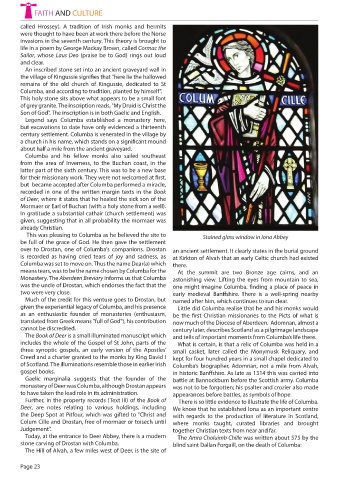
           This was pleasing to Columba as he believed the site to      Stained glass window in Iona Abbey
        be full of the grace of God. He then gave the settlement
        over to Drostan, one of Columba's companions. Drostan   an ancient settlement. It clearly states in the burial ground
        is  recorded  as  having  cried  tears  of  joy  and  sadness,  as   at Kirkton of Alvah that an early Celtic church had existed
        Columba was set to move on. Thus the name Dear(a) which   there.
        means tears, was to be the name chosen by Columba for the   At the summit are two Bronze age cairns, and an
        Monastery. The Aberdeen Breviary informs us that Columba   astonishing view. Lifting the eyes from mountain to sea,
        was the uncle of Drostan, which endorses the fact that the   one might imagine Columba, finding a place of peace in
        two were very close.                                  early medieval Banffshire.  There is a well-spring nearby
          Much of the credit for this venture goes to Drostan, but   named after him, which continues to run clear.
        given the experiential legacy of Columba, and his presence   Little did Columba realise that he and his monks would
        as  an  enthusiastic  founder  of  monasteries  (enthusiasm,   be the first Christian missionaries to the Picts of what is
        translated from Greek means "full of God"), his contribution   now much of the Diocese of Aberdeen.  Adomnan, almost a
        cannot be discredited.                                century later, describes Scotland as a pilgrimage landscape
          The Book of Deer is a small illuminated manuscript which   and tells of important moments from Columba’s life there.
        includes the whole of the Gospel of St John, parts of the   What is certain, is that a relic of Columba was held in a
        three synoptic gospels, an early version of the Apostles’   small casket, later called the Monymusk Reliquary, and
        Creed and a charter granted to the monks by King David I   kept for four hundred years in a small chapel dedicated to
        of Scotland. The illuminations resemble those in earlier Irish   Columba’s biographer, Adomnan, not a mile from Alvah,
        gospel books.                                         in historic Banffshire. As late as 1314 this was carried into
          Gaelic  marginalia  suggests  that  the  founder  of  the   battle at Bannockburn before the Scottish army. Columba
        monastery of Deer was Columba, although Drostan appears   was not to be forgotten; his psalter and crozier also made
        to have taken the lead role in its administration.    appearances before battles, as symbols of hope.
          Further, in the property records (Text III) of the Book of    There is so little evidence to illustrate the life of Columba.
        Deer, are notes relating to various holdings, including   We know that he established Iona as an important centre
        the Deep Spot at Pitfour, which was gifted to "Christ and   with regards  to the production  of literature in Scotland,
        Colum Cille and Drostan, free of mormaer or toisech until   where monks taught, curated libraries and brought
        Judgement".                                           together Christian texts from near and far.
          Today, at the entrance to Deer Abbey, there is a modern   The Amra Choluimb Chille was written about 575 by the
        stone carving of Drostan with Columba.                blind saint Dallan Forgaill, on the death of Columba:
          The Hill of Alvah, a few miles west of Deer, is the site of

        Page 23

