


Page 28 - LOTN Spring Issue 52 2023
P. 28
FAITH AND CULTURE

          The interior of the Church reflects the boldness of
        the exterior.  The feeling of space internally is extremely
        impressive, and the quality and quantity of light enhances
        the internal volume. There is no stained glass to any of the
        windows, these being glazed in leaded clear cathedral,
        enhancing the clear light of the North-East within the
        church.  The details are simple  and stylised,  the arched
        openings with their stepped arch heads and pillars stepped
        in plan, Romanesque in essence yet with a modern, almost
        Art Deco, reference well ahead of its time.
          The soaring, semi-circular arches at the crossing of the
        nave and transepts are more Byzantine in inspiration.
        Above these arches extends the open void within the
        centrally located tower. Windows, high in the tower walls,
        enhance the light value at the crossing point.  There is
        an  interesting  altar  in  the  sanctuary  which  includes  a
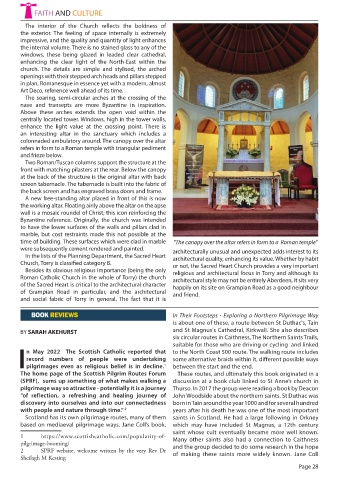
        colonnaded ambulatory around. The canopy over the altar
        refers in form to a Roman temple with triangular pediment
        and frieze below.
          Two Roman/Tuscan columns support the structure at the
        front with matching pilasters at the rear. Below the canopy
        at the back of the structure is the original altar with back
        screen tabernacle. The tabernacle is built into the fabric of
        the back screen and has engraved brass doors and frame.
          A new free-standing altar placed in front of this is now
        the working altar. Floating airily above the altar on the apse
        wall is a mosaic roundel of Christ; this icon reinforcing the
        Byzantine reference. Originally, the church was intended
        to have the lower surfaces of the walls and pillars clad in
        marble, but cost restraints made this not possible at the
        time of building. These surfaces which were clad in marble   "The canopy over the altar refers in form to a  Roman temple"
        were subsequently cement rendered and painted.        architecturally unusual and unexpected adds interest to its
          In the lists of the Planning Department, the Sacred Heart   architectural quality, enhancing its value. Whether by habit
        Church, Torry is classified category B.               or not, the Sacred Heart Church provides a very important
          Besides its obvious religious importance (being the only   religious and architectural focus in Torry and although its
        Roman Catholic Church in the whole of Torry) the church   architectural style may not be entirely Aberdeen, it sits very
        of the Sacred Heart is critical to the architectural character   happily on its site on Grampian Road as a good neighbour
        of Grampian Road in particular, and the architectural   and friend.
        and social fabric of  Torry in general.  The fact that it is

                                                              In Their Footsteps - Exploring a Northern Pilgrimage Way
                                                              is about one of these, a route between St Duthac's, Tain
        BY SARAH AKEHURST                                     and St Magnus's Cathedral, Kirkwall. She also describes
                                                              six circular routes in Caithness, The Northern Saints Trails,
                                                              suitable for those who are driving or cycling  and linked
          n May 2022   The Scottish Catholic reported that  to the North Coast 500 route. The walking route includes
          record numbers of people were undertaking  some alternative braids within it, different possible ways
        Ipilgrimages even as religious belief is in decline.   between the start and the end.
                                                           1
        The home page of the Scottish Pilgrim Routes Forum     These routes, and ultimately this book originated in a
        (SPRF),  sums up something of what makes walking a  discussion at a book club linked to St Anne’s church in
        pilgrimage way so attractive - potentially it is a journey  Thurso. In 2017 the group were reading a book by Deacon
        “of  reflection,  a  refreshing  and healing  journey  of  John Woodside about the northern saints. St Duthac was
        discovery into ourselves and into our connectedness  born in Tain around the year 1000 and for several hundred
        with people and nature through time.”  2              years after his death he was one of the most important
          Scotland has its own pilgrimage routes, many of them  saints in Scotland. He had a large following in Orkney
        based on mediaeval pilgrimage ways. Jane Coll’s book,  which  may have  included  St Magnus, a 12th century
                                                              saint whose cult eventually became more well known.
        1      https://www.scottishcatholic.com/popularity-of-  Many other saints also had a connection to Caithness
        pilgrimage-booming/                                   and the group decided to do some research in the hope
        2      SPRF website, welcome written by the very Rev Dr
        Sheilagh M Kesting                                    of making these saints more widely known. Jane Coll
                                                                                                          Page 28

