


Page 31 - LOTN Spring Issue 52 2023
P. 31
FAITH AND CULTURE


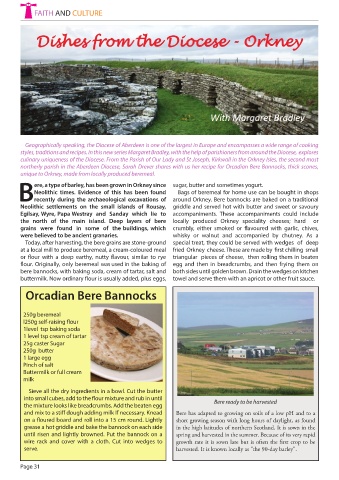
          Geographically speaking, the Diocese of Aberdeen is one of the largest in Europe and encompasses a wide range of cooking
        styles, traditions and recipes. In this new series Margaret Bradley, with the help of parishioners from around the Diocese,  explores
        culinary uniqueness of the Diocese. From the Parish of Our Lady and St Joseph, Kirkwall in the Orkney Isles, the second most
        northerly parish in the Aberdeen Diocese, Sarah Drever shares with us her recipe for Orcadian Bere Bannocks, thick scones,
        unique to Orkney, made from locally produced beremeal.

             ere, a type of barley, has been grown in Orkney since  sugar, butter and sometimes yogurt.
             Neolithic times. Evidence of this has been found   Bags of beremeal for home use can be bought in shops
        Brecently during the archaeological excavations of  around Orkney. Bere bannocks are baked on a traditional
        Neolithic settlements on the small islands of Rousay,  griddle and served hot with butter and sweet or savoury
        Egilsay, Wyre, Papa Westray  and  Sanday  which  lie  to   accompaniments.  These  accompaniments  could  include
        the  north  of  the  main  island.  Deep  layers  of  bere   locally produced Orkney speciality cheeses; hard  or
        grains  were  found  in  some  of  the buildings, which  crumbly, either smoked or flavoured with garlic, chives,
        were believed to be ancient granaries.                whisky or walnut and accompanied by chutney. As a
          Today, after harvesting, the bere grains are stone-ground  special treat, they could be served with wedges  of  deep
        at a local mill to produce beremeal, a cream-coloured meal  fried  Orkney  cheese. These are made by  first chilling  small
        or  flour  with  a  deep  earthy,  nutty  flavour,  similar  to  rye   triangular  pieces of cheese,  then rolling them in beaten
        flour.  Originally,  only  beremeal  was used in  the  baking  of  egg and then in breadcrumbs, and then frying them on
        bere bannocks, with baking soda, cream of tartar, salt and  both sides until golden brown. Drain the wedges on kitchen
        buttermilk. Now ordinary flour is usually added, plus eggs,  towel and serve them with an apricot or other fruit sauce.

          Orcadian Bere Bannocks


         250g beremeal
         l250g self-raising flour
         1level  tsp baking soda
         1 level tsp cream of tartar
         25g caster Sugar
         250g  butter
         1 large egg
         Pinch of salt
         Buttermilk or full cream
         milk

           Sieve all the dry ingredients in a bowl. Cut the butter
         into small cubes, add to the flour mixture and rub in until        Bere ready to be harvested
         the mixture looks like breadcrumbs. Add the beaten egg
         and mix to a stiff dough adding milk If necessary. Knead   Bere has adapted to growing on soils of a low pH and to a
         on a floured board and roll into a 15 cm round. Lightly   short growing season with long hours of daylight, as found
         grease a hot griddle and bake the bannock on each side   in the high latitudes of northern Scotland. It is sown in the
         until risen and lightly browned. Put the bannock on a   spring and harvested in the summer. Because of its very rapid
         wire  rack  and  cover  with  a  cloth.  Cut  into  wedges  to   growth rate it is sown late but is often the first crop to be
         serve.                                                harvested. It is known locally as "the 90-day barley".

        Page 31

