


Page 24 - LOTN Spring Issue 49 2022
P. 24
FAITH AND CULTURE

        by the appearance of a crucifix between the antlers of the
        animal while the king tried to defend himself. As an act of
        thanksgiving for his deliverance, he founded the Abbey of
        Holy Rood, called so in the light of his recent deliverance.
          Firmly dedicated to the promotion of Christianity, David
        began moving north to Moray in 1136. Here he established
        Urquhart Priory, as a Benedictine cell of Dunfermline
        Abbey, adding two Chapels of Ease, at Bellie, on the site
        of the present-day burial ground, and Chapelford, on the
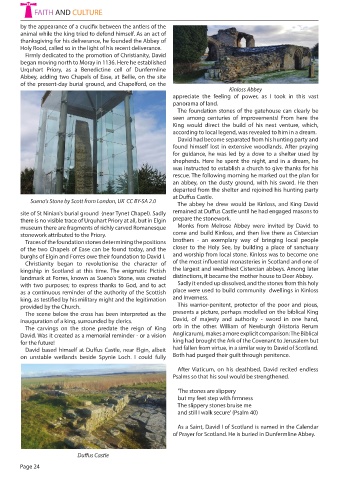
                                                                                  Kinloss Abbey
                                                              appreciate the feeling of power, as I took in this vast
                                                              panorama of land.
                                                               The foundation stones of the gatehouse can clearly be
                                                              seen among centuries of improvements! From here the
                                                              King would direct the build of his next venture, which,
                                                              according to local legend, was revealed to him in a dream.
                                                               David had become separated from his hunting party and
                                                              found himself lost in extensive woodlands. After praying
                                                              for guidance, he was led by a dove to a shelter used by
                                                              shepherds. Here he spent the night, and in a dream, he
                                                              was instructed to establish a church to give thanks for his
                                                              rescue. The following morning he marked out the plan for
                                                              an abbey, on the dusty ground, with his sword. He then
                                                              departed from the shelter and rejoined his hunting party
                                                              at Duffus Castle.
            Sueno's Stone by Scott from London, UK  CC BY-SA 2.0  The abbey he drew would be Kinloss, and King David

        site of St Ninian's burial ground  (near Tynet Chapel). Sadly   remained at Duffus Castle until he had engaged masons to
        there is no visible trace of Urquhart Priory at all, but in Elgin   prepare the stonework.
        museum there are fragments of richly carved Romanesque   Monks from Melrose Abbey were invited by David to
        stonework attributed to the Priory.                   come and build Kinloss, and then live there as Cistercian
          Traces of the foundation stones determining the positions   brothers - an exemplary way of bringing local people
        of the two Chapels of Ease can be found today, and the   closer to the Holy  See, by building a  place of sanctuary
        burghs of Elgin and Forres owe their foundation to David I.  and worship from local stone. Kinloss was to become one
          Christianity began to revolutionise the character of   of the most influential monasteries in Scotland and one of
        kingship  in  Scotland  at  this  time.  The  enigmatic  Pictish   the largest and wealthiest Cistercian abbeys. Among later
        landmark at Forres, known as Sueno's Stone, was created   distinctions, it became the mother house to Deer Abbey.
        with two purposes; to express thanks to God, and to act   Sadly it ended up dissolved, and the stones from this holy
        as a continuous reminder of the authority of the Scottish   place were used to build community  dwellings in Kinloss
        king, as testified by his military might and the legitimation   and Inverness.
        provided by the Church.                                This warrior-penitent, protector of the poor and pious,
          The scene below the cross has been interpreted as the   presents a picture, perhaps modelled on the biblical King
        inauguration of a king, surrounded by clerics.        David, of majesty and authority - sword in one hand,
          The carvings on the stone predate the reign of King   orb in the other.  William of Newburgh (Historia Rerum
        David. Was it created as a memorial reminder - or a vision   Anglicarum), makes a more explicit comparison: The Biblical
        for the future!                                       king had brought the Ark of the Covenant to Jerusalem but
          David based himself at Duffus Castle, near Elgin, albeit   had fallen from virtue, in a similar way to David of Scotland.
        on unstable wetlands beside Spynie Loch. I could fully   Both had purged their guilt through penitence.
                                                               After Viaticum, on his deathbed, David recited endless
                                                              Psalms so that his soul would be strengthened.

                                                               'The stones are slippery
                                                               but my feet step with firmness
                                                               The slippery stones bruise me
                                                               and still I walk secure' (Psalm 40)

                                                               As a Saint, David I of Scotland is named in the Calendar
                                                              of Prayer for Scotland. He is buried in Dunfermline Abbey.


                            Duffus Castle
        Page 24

