


Page 23 - LOTN Spring Issue 49 2022
P. 23
FAITH AND CULTURE

                                                              influence from Canterbury and York. In the twelfth century
                                                              this was a politically charged question of immense
                                                              importance. David’s support for the church emanated
                                                              from his own personal piety, which stemmed from an
                                                              almost damascene shift from the wilderness of youth, back
                                                              to the foundations of his faith which had been so firmly
           Holy StoneS                                        established in childhood.
                                                               In the 8th year of his reign, David is mentioned in the
                                                              (margin) text of an early unfinished copy of the Latin gospels
                                                              known as the Book of Deer. It was written in Aberdeenshire
                                                              and contains many entries in Gaelic, which were added at
                                                              a later date. It is here that the entry mentioning King David
                                                              may be found, and  Text III bears the date, written as '8
                                                              DAVID I'. The year is 1132.
                                                               David built a lasting legacy in Scotland, and in the early

          In the fourth part of her series on  the "Holy" stones which
         mark our faith history in Scotland, Tina Harris examines the
         legacy of St David, King of Scotland.
        St David, the


        reluctant King


               on of St Margaret, Queen of Scotland and
               Malcolm III, David reluctantly became King of
               Scotland  in 1124, crowned  on the  holy Stone
        Sof Scone. King David devoted himself to the
        improvement of a land that would one day defy
        the king of England. He arrived with a whirlwind of
        revolutionary ideas, and began creating new burghs
        and regional markets, a feudal system of land tenure
        to replace the existing system, as well as a revised
        judicial system. He also introduced Scottish coinage,
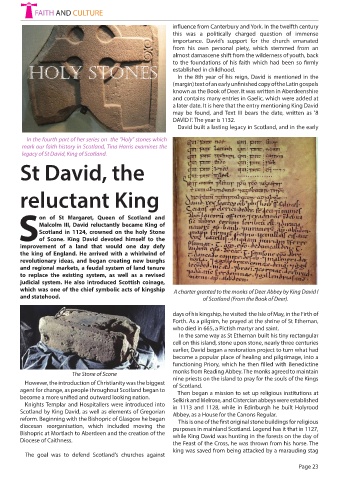
        which was one of the chief symbolic acts of kingship    A charter granted to the monks of Deer Abbey by King David I
        and statehood.                                                  of Scotland (From the Book of Deer).


                                                              days of his kingship, he visited  the Isle of May, in the Firth of
                                                              Forth. As a pilgrim, he prayed at the shrine of St Ethernan,
                                                              who died in 665, a Pictish martyr and saint.
                                                                In the same way as St Ethernan built his tiny rectangular
                                                              cell on this island, stone upon stone, nearly three centuries
                                                              earlier, David began a restoration project to turn what had
                                                              become a popular place of healing and pilgrimage, into a
                                                              functioning Priory, which he then filled with Benedictine
                          The Stone of Scone                  monks from Reading Abbey. The monks agreed to maintain
          However, the introduction of Christianity was the biggest   nine priests on the island to pray for the souls of the Kings
                                                              of Scotland.
        agent for change, as people throughout Scotland began to   Then began a mission to set up religious institutions at
        become a more unified and outward looking nation.     Selkirk and Melrose, and Cistercian abbeys were established
          Knights Templar and Hospitallers were introduced into   in 1113 and 1128, while in Edinburgh he built Holyrood
        Scotland by King David, as well as elements of Gregorian   Abbey, as a House for the Canons Regular.
        reform. Beginning with the Bishopric of Glasgow he began    This is one of the first original stone buildings for religious
        diocesan  reorganisation,  which  included  moving  the   purposes in mainland Scotland. Legend has it that in 1127,
        Bishopric at Mortlach to Aberdeen and the creation of the   while King David was hunting in the forests on the day of
        Diocese of Caithness.                                 the Feast of the Cross, he was thrown from his horse. The
                                                              king was saved from being attacked by a marauding stag
          The  goal  was  to  defend  Scotland's  churches  against
                                                                                                          Page 23

