


Page 27 - LOTN Autumn Issue 48 2021
P. 27
FAITH AND CULTURE
        Mary is a mother


        with mothers


        BY SR JANET FEARNS FMDM

               he is beautiful! The twelfth century church of
               Santiago  is the oldest  in the Spanish  town of A
               Coruña. It is also at the very beginning of the “English
        SWay” of the pilgrimage route to Compostela. There,
        in a tiny Lady chapel, is an exquisite statue of Our Lady –
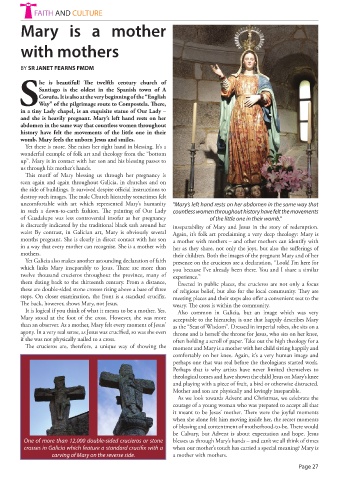
        and she is heavily pregnant. Mary’s left hand rests on her
        abdomen in the same way that countless women throughout
        history have felt the movements of the little one in their
        womb. Mary feels the unborn Jesus and smiles.
          Yet there is more. She raises her right hand in blessing. It’s a
        wonderful example of folk art and theology from the “bottom
        up”. Mary is in contact with her son and his blessing passes to
        us through his mother’s hands.
          This motif of Mary blessing us through her pregnancy is
        seen again and again throughout Galicia, in churches and on
        the side of buildings. It survived despite official instructions to
        destroy such images. The male Church hierarchy sometimes felt
        uncomfortable with art which represented Mary’s humanity  "Mary’s left hand rests on her abdomen in the same way that
        in such a down-to-earth fashion. The painting of Our Lady  countless women throughout history have felt the movements
        of  Guadalupe  was  less  controversial  insofar  as  her  pregnancy   of the little one in their womb."
        is discreetly indicated by the traditional black sash around her   inseparability of Mary and Jesus in the story of redemption.
        waist  By  contrast,  in Galician  art,  Mary  is obviously several   Again, it’s folk art proclaiming a very deep theology: Mary is
        months pregnant. She is clearly in direct contact with her son   a mother with mothers – and other mothers can identify with
        in a way that every mother can recognise. She is a mother with   her as they share, not only the joys, but also the sufferings of
        mothers.                                              their children. Both the images of the pregnant Mary and of her
          Yet Galicia also makes another astounding declaration of faith   presence on the crucieros are a declaration, “Look! I’m here for
        which links Mary inseparably to Jesus. There are more than   you because I’ve already been there. You and I share a similar
        twelve thousand crucieros throughout the province, many of   experience.”
        them dating back to the thirteenth century. From a distance,   Erected in public places, the crucieros are not only a focus
        these are double-sided stone crosses rising above a base of three   of religious belief, but also for the local community. They are
        steps. On closer examination, the front is a standard crucifix.   meeting places and their steps also offer a convenient seat to the
        The back, however, shows Mary, not Jesus.             weary. The cross is within the community.
          It is logical if you think of what it means to be a mother. Yes.   Also common in Galicia, but an image which was very
        Mary stood at the foot of the cross. However, she was more   acceptable to the hierarchy, is one that happily describes Mary
        than an observer. As a mother, Mary felt every moment of Jesus’   as the “Seat of Wisdom”. Dressed in imperial robes, she sits on a
        agony. In a very real sense, as Jesus was crucified, so was she even   throne and is herself the throne for Jesus, who sits on her knee,
        if she was not physically nailed to a cross.          often holding a scroll of paper. Take out the high theology for a
          The  crucieros are,  therefore, a  unique  way  of  showing  the   moment and Mary is a mother with her child sitting happily and
                                                              comfortably on her knee. Again, it’s a very human image and
                                                              perhaps one that was real before the theologians started work.
                                                              Perhaps that is why artists have never limited themselves to
                                                              theological tomes and have shown the child Jesus on Mary’s knee
                                                              and playing with a piece of fruit, a bird or otherwise distracted.
                                                              Mother and son are physically and lovingly inseparable.
                                                               As we look towards Advent and Christmas, we celebrate the
                                                              courage of a young woman who was prepared to accept all that
                                                              it meant to be Jesus’ mother. There were the joyful moments
                                                              when she alone felt him moving inside her, the secret moments
                                                              of blessing and contentment of motherhood-to-be. There would
                                                              be Calvary, but Advent is about expectation and hope. Jesus
         One of more than 12,000 double-sided crucieros or stone   blesses us through Mary’s hands – and can’t we all think of times
         crosses in Galicia which feature a standard crucifix with a   when our mother’s touch has carried a special meaning? Mary is
                   carving of Mary on the reverse side.       a mother with mothers.
                                                                                                          Page 27

