


Page 24 - LOTN Autumn Issue 48 2021
P. 24
FAITH AND CULTURE


          Churches of the


          Diocese of Aberdeen


         The Church of St


         Peter, Aberdeen


          Under the aegis of Archbishop Emeritus Mario Conti we
        continue our series celebrating the rich variety of church
        buildings in the Diocese. The Church of St Peter's, Aberdeen,
        featured in this issue, was completed in 1804 to serve
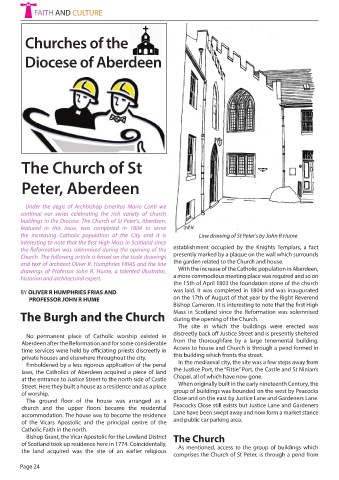
        the  increasing Catholic  population  of the City and  it  is   Line drawing of St Peter's by John R Hume
        interesting to note that the first High Mass in Scotland since
        the Reformation was solemnised during the opening of the   establishment  occupied  by  the  Knights  Templars,  a  fact
        Church. The following article is based on the scale drawings   presently marked by a plaque on the wall which surrounds
        and text of architect Oliver R. Humphries FRIAS and the line   the garden related to the Church and house.
        drawings of Professor John R. Hume, a talented illustrator,   With the increase of the Catholic population in Aberdeen,
        historian and architectural expert.                   a more commodious meeting place was required and so on
                                                              the 15th of April 1803 the foundation stone of the church
        BY OLIVER R HUMPHRIES FRIAS AND                       was laid. It was completed in 1804 and was inaugurated
               PROFESSOR JOHN R HUME                          on the 17th of August of that year by the Right Reverend
                                                              Bishop Cameron. It is interesting to note that the first High
        The Burgh and the Church                              Mass in Scotland since the Reformation was solemnised
                                                              during the opening of the Church.
                                                                The site in which the buildings were erected was
          No permanent place of Catholic worship existed in   discreetly back off Justice Street and is presently sheltered
         Aberdeen after the Reformation and for some considerable   from  the  thoroughfare  by  a  large  tenemental  building.
         time services were held by officiating priests discreetly in   Access to house and Church is through a pend formed in
         private houses and elsewhere throughout the city.    this building which fronts the street.
          Emboldened by a less rigorous application of the penal   In the mediaeval city, the site was a few steps away from
         laws, the Catholics of Aberdeen acquired a piece of land   the Justice Port, the “Fittie” Port, the Castle and St Ninian’s
         at the entrance to Justice Street to the north side of Castle   Chapel, all of which have now gone.
         Street. Here they built a house as a residence and as a place   When originally built in the early nineteenth Century, the
         of worship.                                          group of buildings was bounded on the west by Peacocks
          The ground floor of the house was arranged as a     Close and on the east by Justice Lane and Gardeners Lane.
         church and the upper floors became the residential   Peacocks Close still exists but Justice Lane and Gardeners
         accommodation. The house was to become the residence   Lane have been swept away and now form a market stance
         of the  Vicars Apostolic and the principal centre of the   and public car parking area.
         Catholic Faith in the north.
          Bishop Grant, the Vicar Apostolic for the Lowland District   The Church
         of Scotland took up residence here in 1774. Coincidentally,   As mentioned, access  to the group  of buildings which
         the land acquired was the site of an earlier religious
                                                              comprises the Church of St Peter, is through a pend from
        Page 24

