


Page 31 - LOTN Autumn Issue 48 2021
P. 31
FAITH AND CULTURE

        of the EU, a member of NATO and took on the Euro as its
        currency in January 2014. Today the religions are, in order of
        number of adherents, Lutheran, Catholic, Russian Orthodox
        and Baptist.
          Riga is a lovely city to visit and has the wide Daugava
        River running through it, wide and deep enough for the
        city to have a ferry port with daily sailings to Stockholm,
        Sweden. Strolling along the embankment you will come
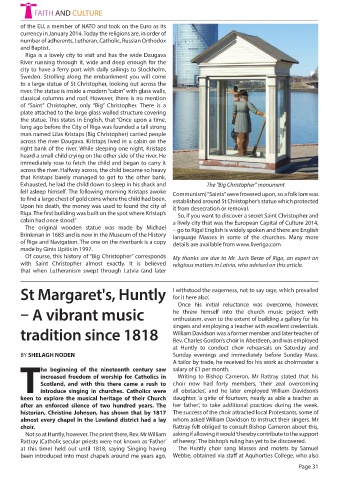
        to a large statue of St Christopher, looking out across the
        river. The statue is inside a modern “cabin” with glass walls,
        classical columns and roof. However, there is no mention
        of  “Saint” Christopher, only  “Big” Christopher.  There is a
        plate attached to the large glass walled structure covering
        the statue. This states in English, that “Once upon a time,
        long ago before the City of Riga was founded a tall strong
        man named Lilas Kristaps (Big Christopher) carried people
        across the river Daugava. Kristaps lived in a cabin on the
        right bank of the river. While sleeping one night, Kristaps
        heard a small child crying on the other side of the river. He
        immediately rose to fetch the child and began to carry it
        across the river. Halfway across, the child became so heavy
        that Kristaps barely managed to get to the other bank.
        Exhausted, he laid the child down to sleep in his shack and       The "Big Christopher" monument
        fell asleep himself. The following morning Kristaps awoke   Communism) “Saints” were frowned upon, so a folk lore was
        to find a large chest of gold coins where the child had been.   established around St Christopher’s statue which protected
        Upon his death, the money was used to found the city of   it from desecration or removal.
        Riga. The first building was built on the spot where Kristap’s   So, if you want to discover a secret Saint Christopher and
        cabin had once stood.”                                a lively city that was the European Capital of Culture 2014,
          The original wooden statue  was made by Michael     – go to Riga! English is widely spoken and there are English
        Brinkman in 1683 and is now in the Museum of the History   language Masses in some of the churches. Many more
        of Riga and Navigation. The one on the riverbank is a copy   details are available from www.liveriga.com
        made by Gints Upitis in 1997.
          Of course, this history of “Big Christopher” corresponds   My thanks are due to Mr. Juris Berze of Riga, an expert on
        with Saint Christopher almost exactly. It is believed   religious matters in Latvia, who advised on this article.
        that when Lutheranism swept through Latvia (and later


        St Margaret's, Huntly                                 I withstood the eagerness, not to say rage, which prevailed
                                                              for it here also’.
                                                               Once his initial reluctance was overcome, however,
        – A vibrant music                                     he threw himself into the church music project with
                                                              enthusiasm, even to the extent of building a gallery for his
        tradition since 1818                                  singers and employing a teacher with excellent credentials.
                                                              William Davidson was a former member and later teacher of
                                                              Rev. Charles Gordon’s choir in Aberdeen, and was employed
                                                              at Huntly to conduct choir rehearsals on Saturday and
        BY SHELAGH NODEN                                      Sunday evenings and immediately before Sunday Mass.
                                                              A tailor by trade, he received for his work as choirmaster a
               he  beginning  of  the  nineteenth  century  saw  salary of £1 per month.
               increased freedom of worship for Catholics in   Writing to Bishop Cameron, Mr Rattray stated that his
               Scotland, and with this there came a rush to  choir now had forty members,  ‘their zeal overcoming
        Tintroduce singing in churches. Catholics were  all obstacles’, and he later employed  William Davidson’s
        keen to explore the musical heritage of their Church  daughter, ‘a girlie of fourteen, nearly as able a teacher as
        after an enforced silence of two hundred years.  The  her father’, to take additional practices during the week.
        historian,  Christine  Johnson, has  shown  that by  1817  The success of the choir attracted local Protestants, some of
        almost  every  chapel in  the  Lowland  district had  a  lay  whom asked William Davidson to instruct their singers. Mr
        choir.                                                Rattray felt obliged to consult Bishop Cameron about this,
          Not so at Huntly, however. The priest there, Rev. Mr William  asking if allowing it would ‘thereby contribute to the support
        Rattray (Catholic secular priests were not known as ‘Father’  of heresy’. The bishop’s ruling has yet to be discovered.
        at this time) held out until 1818, saying ‘Singing having   The Huntly choir sang Masses and motets by Samuel
        been introduced into most chapels around me years ago,  Webbe, obtained via staff at Aquhorties College, who also
                                                                                                          Page 31

