


Page 31 - LOTN Spring Issue 49 2022
P. 31
FAITH AND CULTURE

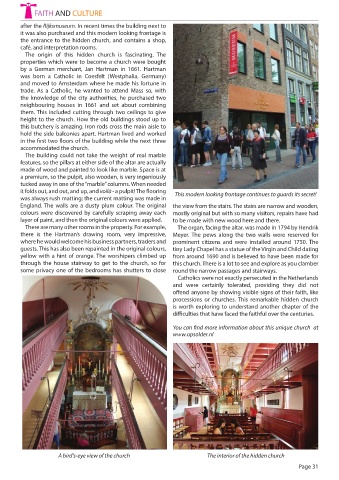
        after the Rijksmuseum. In recent times the building next to
        it was also purchased and this modern looking frontage is
        the entrance to the hidden church, and contains a shop,
        café, and interpretation rooms.
          The origin of this hidden church is fascinating.  The
        properties which were to become a church were bought
        by a German merchant, Jan Hartman in 1661. Hartman
        was born a Catholic in Coesfelt (Westphalia, Germany)
        and moved to Amsterdam where he made his fortune in
        trade. As a Catholic, he wanted to attend Mass so, with
        the knowledge of the city authorities, he purchased two
        neighbouring houses in 1661 and set about combining
        them. This included cutting through two ceilings to give
        height to the church. How the old buildings stood up to
        this butchery is amazing. Iron rods cross the main aisle to
        hold the side balconies apart. Hartman lived and worked
        in the first two floors of the building while the next three
        accommodated the church.
          The building could not take the weight of real marble
        features, so the pillars at either side of the altar are actually
        made of wood and painted to look like marble. Space is at
        a premium, so the pulpit, also wooden, is very ingeniously
        tucked away in one of the “marble” columns. When needed
        it folds out, and out, and up, and voilà - a pulpit! The flooring   This modern looking frontage continues to guards its secret!
        was always rush matting; the current matting was made in
        England. The walls are a dusty plum colour. The original  the view from the stairs. The stairs are narrow and wooden,
        colours were discovered by carefully scraping away each  mostly original but with so many visitors, repairs have had
        layer of paint, and then the original colours were applied.   to be made with new wood here and there.
          There are many other rooms in the property. For example,   The organ, facing the altar, was made in 1794 by Hendrik
        there is the Hartman’s drawing room, very impressive,  Meyer. The pews along the two walls were reserved for
        where he would welcome his business partners, traders and  prominent citizens and were installed around 1750.  The
        guests. This has also been repainted in the original colours,   tiny Lady Chapel has a statue of the Virgin and Child dating
        yellow with a hint of orange. The worshipers climbed up  from around 1690 and is believed to have been made for
        through the house stairway to get to the church, so for  this church. There is a lot to see and explore as you clamber
        some privacy one of the bedrooms has shutters to close  round the narrow passages and stairways.
                                                               Catholics were not exactly persecuted in the Netherlands
                                                              and were certainly tolerated, providing they did not
                                                              offend anyone by showing visible signs of their faith, like
                                                              processions  or  churches. This  remarkable  hidden  church
                                                              is worth exploring to understand another chapter of the
                                                              difficulties that have faced the faithful over the centuries.

                                                              You can find more information about this unique church  at
                                                              www.opsolder.nl


                      A bird's-eye view of the church                     The interior of the hidden church
                                                                                                          Page 31

