


Page 26 - LOTN Summer issue 56 2024
P. 26
FAITH AND CULTURE
        Witold Pilecki - A hero for our times


          The 5  of  September  this  year will  mark the 12th
               th
        anniversary of the posthumous promotion of the late cavalry
        officer Witold Pilecki to the rank of colonel of the Polish army.
        He  was  an  extraordinary  figure,  a  model  for  subsequent
        generations of Poles and all those who search in their hearts
        for what is right and just. In the 1970s, the British historian
        Michael Foot, in his book Six Faces of Courage, recognized
        Witold as one of the six bravest heroes of World War II, and
        in the first of two articles Lidia Konar recounts the incredible
        story of this amazing patriot who whas left an indelible mark
        on Polish history.
        BY LIDIA KONAR

                    itold Pilecki was born on the 13  of May,
                                                  th
                    1901 in Olonets, a city in north-western
                    Russia. He came from a Polish noble family.
        WHis grandfather Joseph had lost almost all
        his property for participating in the January Uprising
                                                           1
        and the family had to leave for Russia. Then Joseph’s
        son, Julian, could not find a job in the former Polish-
        Lithuanian Commonwealth, as he was the son of an
        insurgent. People like him were severely victimised by
        the Russian invaders. After completing his studies in St
        Petersburg, Julian had to work as a forester in distant
        Karelia .  There he married Ludwika Osiecimska.  The
               2
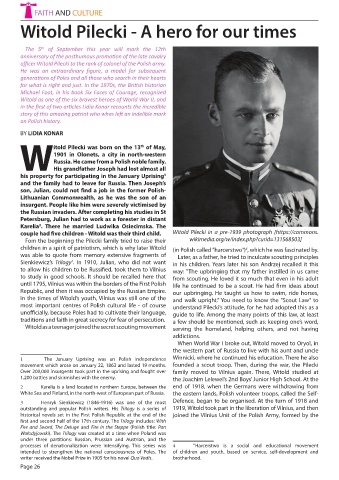
        couple had five children - Witold was their third child.  Witold Pilecki in a pre-1939 photograph [https://commons.
          Fom the beginning the Pilecki family tried to raise their   wikimedia.org/w/index.php?curid=131568503]
        children in a spirit of patriotism, which is why later Witold   (in Polish called "harcerstwo") , which he was fascinated by.
                                                                                       4
        was able to quote from memory extensive fragments of   Later, as a father, he tried to inculcate scouting principles
        Sienkiewicz’s  Trilogy . In 1910, Julian, who did not want   in his children. Years later his son Andrzej recalled it this
                          3
        to allow his children to be Russified, took them to Vilnius   way: "The upbringing that my father instilled in us came
        to study in good schools. It should be recalled here that   from scouting. He loved it so much that even in his adult
        until 1795, Vilnius was within the borders of the First Polish   life he continued to be a scout. He had firm ideas about
        Republic, and then it was occupied by the Russian Empire.   our upbringing. He taught us how to swim, ride horses,
        In the times of Witold’s youth, Vilnius was still one of the   and walk upright.” You need to know the "Scout Law" to
        most important centres of Polish cultural life - of course   understand Pilecki’s attitude, for he had adopted this as a
        unofficially, because Poles had to cultivate their language,   guide to life. Among the many points of this law, at least
        traditions and faith in great secrecy for fear of persecution.  a few should be mentioned, such as: keeping one’s word,
          Witold as a teenager joined the secret scouting movement   serving the homeland, helping others, and not having
                                                              addictions.
                                                               When World War I broke out, Witold moved to Oryol, in
                                                              the western part of Russia to live with his aunt and uncle
        1        The  January  Uprising  was  an  Polish  independence  Winnicki, where he continued his education. There he also
        movement which arose on January 22, 1863 and lasted 19 months.  founded a scout troop. Then, during the war, the Pilecki
        Over 200,000 insurgents took part in the uprising and fought over  family moved to  Vilnius again.  There,  Witold studied at
        1,200 battles and skirmishes with the enemy.          the Joachim Lelewel’s 2nd Boys’ Junior High School. At the
        2      Karelia is a land located in northern Europe, between the  end of 1918, when the Germans were withdrawing from
        White Sea and Finland, in the north-west of European part of Russia.  the eastern lands, Polish volunteer troops, called the Self-
        3      Henryk Sienkiewicz (1846-1916) was one of the most   Defence, began to be organised. At the turn of 1918 and
        outstanding and popular Polish writers. His  Trilogy is a series of  1919, Witold took part in the liberation of Vilnius, and then
        historical  novels  set  in  the  First  Polish  Republic  at  the  end  of  the  joined the Vilnius Unit of the Polish Army, formed by the
        first and second half of the 17th century. The Trilogy includes: With
        Fire and Sword, The Deluge and  Fire in the Steppe  (Polish title:  Pan
        Wołodyjowski). The Trilogy was created at a time when Poland was
        under three partitions: Russian, Prussian and Austrian, and the
        processes of denationalization were intensifying.  This series was   4   "Harcerstwo is a social and educational movement
        intended  to strengthen  the national  consciousness  of  Poles.  The   of children and youth, based on service, self-development and
        writer received the Nobel Prize in 1905 for his novel Quo Vadis.  brotherhood.
        Page 26

