


Page 22 - LOTN Summer issue 56 2024
P. 22
FAITH AND CULTURE


         Monastic


         Lessons from the


         Beeatitudes


                  "A work of art; and yet no art of man,
              Can work, this work, these little creatures can."
                                               Geffrey Whitney
          In the second of a series of fascinating articles Fr Benedict
        Hardy OSB of Pluscarden Abbey reflects on the contribution
        to bee keeping made by probably the world’s most famous
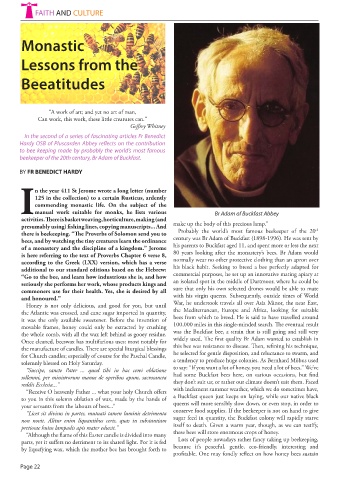
        beekeeper of the 20th century, Br Adam of Buckfast.

        BY FR BENEDICT HARDY


             n the year 411 St Jerome wrote a long letter (number
             125 in the collection) to a certain Rusticus, ardently
             commending monastic life. On the subject of the
        Imanual  work  suitable  for  monks,  he  lists  various            Br Adam of Buckfast Abbey
         activities. There is basket weaving, horticulture, making (and
         presumably using) fishing lines, copying manuscripts... And   make up the body of this precious lamp.”
                                                                                                                th
         there is beekeeping. “The Proverbs of Solomon send you to   Probably the world’s most famous beekeeper of the 20
         bees, and by watching the tiny creatures learn the ordinance   century was Br Adam of Buckfast (1898-1996). He was sent by
         of a monastery and the discipline of a kingdom.” Jerome   his parents to Buckfast aged 11, and spent more or less the next
         is here referring to the text of Proverbs Chapter 6 verse 8,   80 years looking after the monastery’s bees. Br Adam would
         according to the Greek (LXX) version, which has a verse   normally wear no other protective clothing than an apron over
         additional to our standard editions based on the Hebrew:                                                                                                         his black habit. Seeking to breed a bee perfectly adapted for
         “Go to the bee, and learn how industrious she is, and how   commercial purposes, he set up an innovative mating apiary at
         seriously she performs her work, whose products kings and   an isolated spot in the middle of Dartmoor, where he could be
         commoners use for their health. Yes, she is desired by all   sure that only his own selected drones would be able to mate
         and honoured.”                                       with his virgin queens. Subsequently, outside times of World
          Honey is not only delicious, and good for you, but until   War, he undertook travels all over Asia Minor, the near East,
         the Atlantic was crossed, and cane sugar imported in quantity,   the Mediterranean, Europe and Africa, looking for suitable
         it was the only available sweetener. Before the invention of   bees from which to breed. He is said to have travelled around
         movable frames, honey could only be extracted by crushing   100,000 miles in this single-minded search. The eventual result
         the whole comb, with all the wax left behind as gooey residue.   was the Buckfast bee, a strain that is still going and still very
         Once cleaned, beeswax has multifarious uses: most notably for   widely used. The first quality Br Adam wanted to establish in
         the manufacture of candles. There are special liturgical blessings   this bee was resistance to disease. Then, refining his technique,
         for Church candles; especially of course for the Paschal Candle,   he selected for gentle disposition, and reluctance to swarm, and
         solemnly blessed on Holy Saturday.                   a tendency to produce huge colonies. As Bernhard Möbus used
          “Suscipe, sancte Pater ... quod tibi in hac cerei oblatione   to say: “If you want a lot of honey, you need a lot of bees.” We’ve
         sollemni, per ministrorum manus de operibus apum, sacrosancta   had some Buckfast bees here, on various occasions, but find
         reddit Ecclesia...”                                  they don’t suit us; or rather our climate doesn’t suit them. Faced
          “Receive O heavenly Father ... what your holy Church offers   with inclement summer weather, which we do sometimes have,
         to you in this solemn oblation of wax, made by the hands of   a Buckfast queen just keeps on laying, while our native black
         your servants from the labours of bees...”           queens will more sensibly slow down, or even stop, in order to
          “Licet sit divisus in partes, mutuati tamen luminis detrimenta   conserve food supplies. If the beekeeper is not on hand to give
         non novit. Alitur enim liquantibus ceris, quas in substantiam   sugar feed in quantity, the Buckfast colony will rapidly starve
         pretiosae huius lampadis apis mater eduxit.”         itself to death. Given a warm year, though, as we can testify,
          “Although the flame of this Easter candle is divided into many   these bees will store enormous crops of honey.
         parts, yet it suffers no detriment to its shared light. For it is fed   Lots of people nowadays rather fancy taking up beekeeping,
         by liquefying wax, which the mother bee has brought forth to   because it’s peaceful, gentle, eco-friendly, interesting and
                                                              profitable. One may fondly reflect on how honey bees sustain

        Page 22

