


Page 10 - LOTN Autumn Issue 48 2021
P. 10
DIOCESE

                                                              bishops eventually banned the practice in 1838 – the fact the
                                                              Anglican liturgical chants were banned indicates their use must
                                                              have been widespread at this time.
                                                               Thankfully in the Apostolic Constitution of 2009,
                                                              Anglicanorum coetibus, the document commends the use of
                                                              ’liturgical celebrations according to the books proper to the
                                                              Anglican tradition, which have been approved by the Holy See,
                                                              so as to maintain the liturgical, spiritual and pastoral traditions
                                                              of the Anglican Communion within the Catholic Church, as a
                                                              precious gift nourishing the members of the Ordinariate, and as
                                                              a treasure to be shared.’ That ‘treasure’ was certainly shared at
                                                              the Mass at Tynet.
                                                               After a picnic lunch, we heard a little of the history of the
                                                              church at Tynet and then we made our way to St Gregory’s
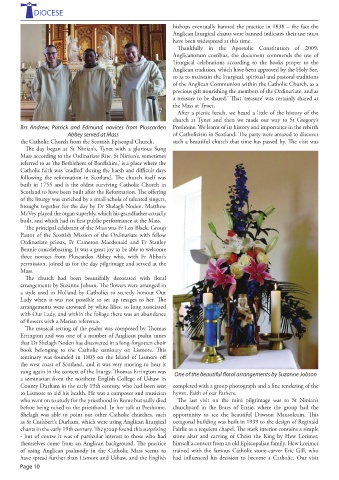
        Brs Andrew, Patrick and Edmund, novices from Pluscarden   Preshome. We learnt of its history and importance in the rebirth
                         Abbey served at Mass                 of Catholicism in Scotland. The party were amazed to discover
        the Catholic Church from the Scottish Episcopal Church.  such a beautiful church that time has passed by. The visit was
          The  day  began  at  St  Ninian’s, Tynet  with  a  glorious  Sung
        Mass according to the Ordinariate Rite. St Ninian’s, sometimes
        referred to as ‘the Bethlehem of Banffshire,’ is a place where the
        Catholic faith was ‘cradled’ during the harsh and difficult days
        following the reformation in Scotland. The church itself was
        built in 1755 and is the oldest surviving Catholic Church in
        Scotland to have been built after the Reformation. The offering
        of the liturgy was enriched by a small schola of talented singers,
        brought together for the day by Dr Shelagh Noden. Matthew
        McVey played the organ superbly, which his grandfather actually
        built, and which had its first public performance at the Mass.
          The principal celebrant of the Mass was Fr Len Black, Group
        Pastor of the Scottish Mission of the Ordinariate with fellow
        Ordinariate priests, Fr Cameron Macdonald and Fr Stanley
        Bennie concelebrating. It was a great joy to be able to welcome
        three novices  from Pluscarden Abbey who, with  Fr Abbot’s
        permission, joined us for the day pilgrimage and served at the
        Mass.
          The church had been beautifully decorated with floral
        arrangements by Suzanne Jobson. The flowers were arranged in
        a style used in Holland by Catholics to secretly honour Our
        Lady when it was not possible to set up images to her. The
        arrangements were crowned by white lilies, so long associated
        with Our Lady, and within the foliage there was an abundance
        of flowers with a Marian reference.
          The musical setting of the psalm was composed by Thomas
        Errington and was one of a number of Anglican psalm tunes
        that Dr Shelagh Noden has discovered in a long-forgotten choir
        book  belonging  to  the  Catholic  seminary  on  Lismore.  This
        seminary was founded in 1803 on the Island of Lismore off
        the west coast of Scotland, and it was very moving to hear it
        sung again in the context of the liturgy. Thomas Errington was   One of the beautiful floral arrangements by Suzanne Jobson
        a seminarian from the northern English College of Ushaw in
        County Durham in the early 19th century, who had been sent  completed with a group photograph and a fine rendering of the
        to Lismore to aid his health. He was a composer and musician  hymn, Faith of our Fathers.
        who went on to study for the priesthood in Rome but sadly died   The last visit on the mini pilgrimage was to St Ninian’s
        before being raised to the priesthood. In her talk at Preshome,  churchyard in the Braes of Enzie, where the group had the
        Shelagh was able to point out other Catholic churches, such  opportunity  to see  the beautiful  Dawson  Mausoleum.  This
        as St Cuthbert’s Durham, which were using Anglican liturgical  octagonal building was built in 1939 to the design of Reginald
        chants in the early 19th century. The group found this surprising  Fairlie as a requiem chapel. The stark interior contains a simple
        - but of course it was of particular interest to those who had  stone altar and carving of Christ the King by Hew Lorimer,
        themselves come from an Anglican background. The practice  himself a convert from an old Episcopalian family. Hew Lorimer
        of  using  Anglican  psalmody  in  the  Catholic  Mass  seems  to  trained with the famous Catholic stone-carver Eric Gill, who
        have spread further than Lismore and Ushaw, and the English  had influenced his decision to become a Catholic. Our visit
        Page 10

